
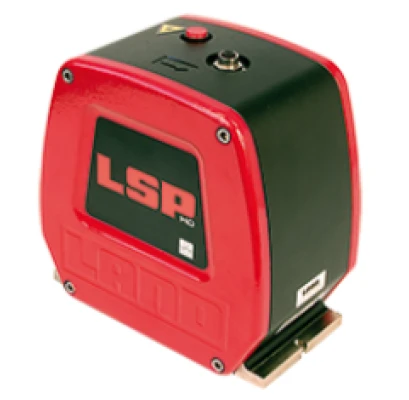
LANDSCAN LSP-HD Infrared Line Scanner
Key Features
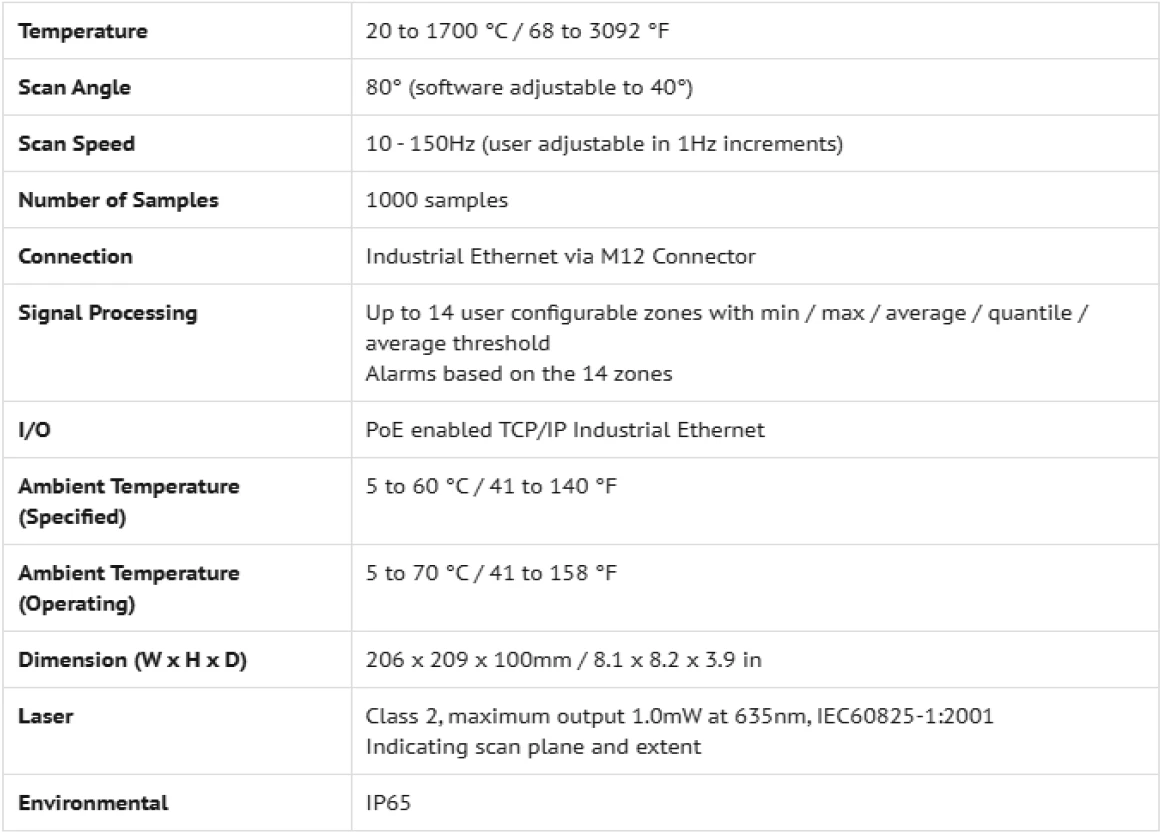
- High-speed scanning with up to 150 scans per second
- Captures 1,000 temperature data points per scan
- Measures temperatures from 20°C to 1700°C
- Simple single Ethernet (PoE) connection for fast installation
- No external processor required
- Rugged optics with sapphire protection for harsh environments
- Compatible with existing LANDSCAN installations and WCA software
- Supports direct integration with PLCs and industrial automation systems
- Ideal for steel, glass, and industrial processing applications
MODELS
LSP-HD 10–12
600–1700 °C (Continuous Caster, Reheat Furnace Exit, Hot Strip Mill, Hot Plate Mill, Hot Beam Mill)
LSP-HD 20–23
200–1200 °C (Continuous Annealing Lines, Annealing Furnaces, Galvanizing/Galvanneal Lines, Hot Strip Mill, Hot Plate Mill)
LSP-HD 5FL/50–52
150–1100 °C (Float Glass, Lehr, Glass Tempering, Glass Forming, Glass Coating, Solar Panels)
LSP-HD 60–63
20–850 °C (Paper, Rotary Kilns, Non-woven Dryers, Thermoforming, Plastic Extruders, Galvanizing Lines)
LSP-HD 71
50–350 °C (Plastic Polymers, Thin Plastics, Plastic Thermoforming, Steel Paint Coating Lines)
What does an infrared linescanner do?
- Creates a continuous thermal image of moving products.
- Scans a single line at high speed to build a 2D temperature map.
- Detects hot and cold spots across the full product width.
- Ideal for continuous industrial process monitoring.
- What is the scan rate of the LSP-HD?
- Scans up to 150 lines/second with 1,000 samples per line.
- Measures temperatures from 20°C to 1,700°C.
- Covers process widths from 0.15 m to over 100 m.
- Captures fine temperature variations on fast-moving products.
Which industries use linescanners?
- Cement (rotary kilns)
- Steel strip processing
- Glass tempering & annealing
- Paper & board manufacturing
- Textile heat treatment
- Asphalt production
- Any continuous process requiring full-width temperature monitoring
Does the LSP-HD work with ImagePro?
- Fully compatible with LAND ImagePro V2 software.
- Supports live visualization and zone analysis.
- Provides alarms and long-term data trending.
- Uses Power over Ethernet (PoE) for simple installation.
- Can it monitor cement kilns?
- Yes, designed for continuous rotary kiln shell scanning.
- Detects hot spots before failures occur.
- Reduces maintenance costs and unplanned downtime.
- Extends kiln life and improves plant reliability.
RELATED APPLICATIONS
Super Calendering
Detects hot spots on calender rolls. Prevents roll damage and costly repairs. Ensures reliable roll performance.
Thermoforming
Monitors plastic sheet temperature. Ensures consistent product formation. Improves product quality and reduces defects.
Torpedo Car
Monitors refractory lining condition. Detects deterioration before failure. Improves operational safety and reliability.
Photovoltaic Module Assembly
Provides high-resolution thermal imaging. Detects small defects during production. Improves solar module quality.
Hot Bridle
Measures edge-to-edge strip temperature. Verifies temperature uniformity. Supports stable strip processing.
Overaging
Provides non-contact edge-to-edge temperature monitoring. Ensures uniform heating across the strip. Improves process control.
Top Roll
Monitors temperature across the full strip width. Detects uneven heating. Enhances product consistency.
Kiln Shell
Continuously scans kiln shell temperature. Detects refractory lining issues early. Reduces downtime and maintenance costs.